Around the first birthday, play starts to spread well beyond grasping and dropping. A child may want to post objects through openings, stack and unstack, fill containers, push a wagon, carry baskets, turn pages, make music, imitate cleaning, explore art materials, or hear the names of everything they encounter.
The best Montessori toys for 1 year olds reflect that range without filling the home with materials for every possible skill. At 12 months, simple activities with a clear action often make more sense than complicated products purchased several stages ahead.
Manufacturer age guidance remains the first filter. From there, consider what the child is already trying to do, how independently they can participate, and whether the material provides useful repetition rather than simply adding more features.
The first birthday is a transition rather than a clean break from infancy.
A 12 month old may still enjoy familiar activities such as balls, containers, rattles, object permanence, nesting cups, and removing pieces. What changes is often the intention behind the action.
An object may be deliberately placed into a container instead of accidentally dropped. A puzzle piece may be removed with purpose. A ball may be pushed toward another person. A basket might be filled, carried, emptied, and filled again.
Movement also becomes increasingly important. Crawling, standing, cruising, walking, pushing, pulling, carrying, and climbing can occupy as much interest as anything displayed on a toy shelf.
That is why this page should not be treated as a list of fine motor toys alone.
A useful clue at this age is what the child does over and over without being asked.
A child repeatedly putting objects through openings may be ready for a posting activity. One who carries household items everywhere may enjoy a manageable basket or wagon. A toddler fascinated by wiping and sweeping may be more interested in Practical Life than another puzzle.
The strongest choice often extends an existing interest rather than trying to introduce several new ones at once.
A one-year-old does not need every activity described on this page. Quality, variety across the environment, and good timing matter more than quantity.
Posting builds naturally from the deliberate dropping that begins during later infancy.
A simple activity might involve one large object and one clearly visible opening. The child picks up the object, aligns it, releases it, retrieves it, and starts again.
This is considerably easier to understand than a complicated shape sorter containing several shapes and openings.
Coin boxes, large-disc posting toys, ball drops, and simple slot activities can all fit this category when their components and manufacturer age guidance are appropriate.
The best design makes retrieval easy enough that the child can repeat the sequence rather than depending on an adult to reset it after every turn.
Object permanence toys do not suddenly become unnecessary at 12 months.
An activity introduced earlier can become more deliberate as the child learns to release the ball, watch where it goes, retrieve it independently, operate a simple drawer, or repeat the sequence more efficiently.
A ball tracker introduces a related activity by keeping the moving object visible for longer.
If ball-based repetition is a strong interest, our guide to Montessori ball toys compares drops, trackers, ramps, rolling toys, and similar designs in more detail.
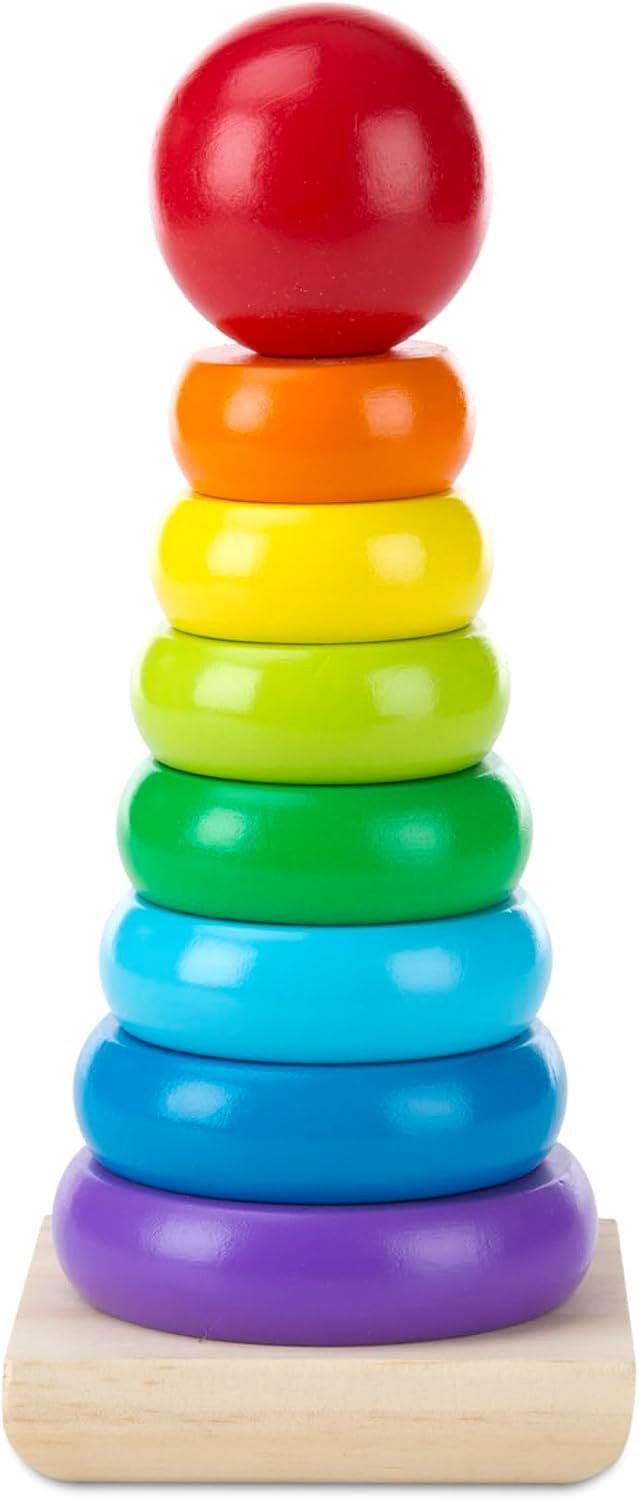
At one, successful stacking is only part of the activity.
A child may spend far more time taking rings off a post, separating nesting cups, knocking down a tower, carrying pieces, placing objects inside cups, or trying to replace one item at a time.
That does not mean the toy is being used incorrectly.
A well-designed stacker can remain useful as the child’s coordination develops because taking apart, replacing, ordering, and building emerge at different times.
Piece size, base stability, total number of pieces, storage, and how easily the set can be reset all affect practical use.
You can compare different formats in our guide to Montessori stacking toys.
A first puzzle does not need several pieces.
At around 12 months, a large single-shape puzzle or board with only a few chunky pieces may provide enough challenge. Removing the pieces can come before successfully returning them.
Knobs or other easy gripping points may help, but the exact construction matters. Pieces should be appropriately sized for the manufacturer’s intended age and sturdy enough for repeated handling.
The challenge can grow gradually. More involved fitting and matching belong later rather than being purchased early in the hope that the child will grow into them quickly.
Our broader Montessori puzzles guide looks at how piece count, shape, orientation, handles, and visual cues change the difficulty.
One-year-olds may become intensely interested in lids, doors, drawers, containers, zippers, and other mechanisms.
A simple opening-and-closing activity can offer plenty of repetition without needing lights or electronic feedback.
The mechanism should match the child’s hands. A loose lid is very different from a threaded cap, stiff buckle, or complicated latch.
Household containers can sometimes provide the activity just as well as a dedicated toy, provided they are safe, appropriately sized, clean, and free from unsuitable components.
One-year-olds frequently enjoy moving objects from one place to another.
A basket of large balls may be emptied onto the floor, refilled, carried across the room, and emptied again. Blocks might be loaded into a wagon. Cloths may be moved between baskets.
Transporting is easy to overlook because it does not look like a conventional educational toy, but it can be one of the most absorbing activities during the second year.
Baskets, buckets, small wagons, and other suitable containers can support this interest without adding complicated mechanisms.
Balls remain one of the more versatile materials around the first birthday.
A child can roll, push, carry, chase, drop, throw, place, or retrieve them. Different sizes and textures also change the activity without requiring a completely different toy.
A ball intended for a one-year-old should be judged according to its exact size, weight, firmness, material, cleanability, and manufacturer age guidance.
A ball that rolls quickly across a large room offers a different challenge from a textured ball that is easier to grip and control.
A one-year-old’s environment should not revolve around shelf work.
Walking, carrying, pushing, pulling, crawling through spaces, climbing appropriate structures, and moving objects can be central interests during this stage.
Pull toys, stable wagons, tunnels, balls, carrying baskets, and appropriately designed movement equipment can all give physical effort a purpose.
Push products deserve particular scrutiny. Stability, wheel speed, handle position, weight, and manufacturer guidance matter, especially when a child is still developing independent mobility.
A toy should support movement the child is already initiating rather than being used to force standing or walking.
Our guide to Montessori pull toys looks more closely at toys built around movement and transport.
One of the biggest opportunities around age one is outside the toy box.
Children often become deeply interested in what adults are doing. They may want to wipe, carry, stir, put something into a basket, brush, pour with help, place clothing somewhere, or imitate a simple household routine.
A small cloth, appropriately sized brush, cup, spoon, bowl, basket, or other functional item can sometimes provide a more meaningful activity than a toy designed to imitate the same task.
The object should actually work.
A child-sized utensil that is difficult to grip or a decorative broom that cannot sweep does little to support independence simply because it looks Montessori.
Our guide to Montessori Practical Life toys covers functional tools and activities in more detail.
A one-year-old does not need a complete toy kitchen to participate in food-related work.
Depending on the child and the task, early involvement might include carrying a spoon, placing something into a bowl, stirring with help, wiping a surface, moving food from one container to another, or drinking from appropriately sized tableware.
As coordination develops, the activity can become more involved.
Tools should be chosen for the exact task rather than assembled into a large set just because they are child-sized. Weight, grip, breakability, sharpness, cleaning, and adult supervision all matter.
Independence at this age can include small parts of everyday routines.
A low hook, reachable basket, small cloth, accessible brush, suitable chair, or predictable place for shoes can help the child participate in dressing, grooming, cleanup, or putting belongings away.
These are environment decisions rather than toys, but they can matter more to Montessori-inspired independence than adding another tabletop activity.
The goal is not for a one-year-old to complete routines perfectly. It is to make participation possible.
Language development does not require a talking electronic toy.
At one, the child’s entire environment provides language opportunities. Adults name objects, describe routines, read books, notice animals outside, talk about food, and respond to what the child is pointing toward or carrying.
Books with clear photographs or realistic illustrations can support those conversations.
A small collection of realistic objects or figures may also be useful for naming and matching later, provided every piece is appropriate for the child’s age. Manufacturer guidance and component size are especially important because many detailed miniature figures are intended for older children.
If a real object can be handled safely, it often provides more information than a picture alone.
A spoon has weight, temperature, texture, and a real function. A leaf can be touched and smelled. A ball rolls.
Pictures become useful for things that cannot practically be brought into the room, or for beginning to connect a real object with its representation.
Simple picture cards can therefore support language, but they do not need to be presented as drills or used to test whether the child knows the answer.
A one-year-old may enjoy very simple books with familiar objects, animals, faces, routines, or short stories.
As attention grows, books can gradually become more detailed.
Durable pages, manageable size, clear imagery, and subject matter connected to the child’s experiences tend to be more relevant than whether the book itself is marketed as Montessori.
Realistic stories can be especially useful when they connect with familiar experiences such as dressing, eating, sleeping, visiting a park, seeing animals, or spending time with family.
Music offers a clear action-and-result relationship when the child produces the sound.
Shakers, drums, bells, xylophones, and other age-appropriate instruments can be explored through movement and repetition.
At one, simple instruments usually make more sense than products with many musical modes and buttons.
Consider grip, sound level, construction, detachable parts, cleaning, and manufacturer guidance. An instrument that sounds good to an adult is not automatically appropriate for a child this age.
For a wider range of child-controlled sound activities, see our guide to Montessori music toys.
Early art at one is primarily about using the material rather than producing recognizable images.
Depending on manufacturer guidance and supervision, suitable crayons, finger paints, modeling materials, paper, or large stickers may allow the child to make marks, press, spread, peel, place, or manipulate a new medium.
The activity should be simple enough that most of the time is spent exploring rather than waiting for an adult to prepare an elaborate craft.
Washability and cleanup matter considerably at this age.
Specific art supplies should always be checked for the intended age and use rather than assumed appropriate because they are labeled washable or child-friendly.
Fine motor products for one-year-olds often include posting, pegging, threading, sorting, pounding, twisting, or fitting.
Those actions do not all belong at the same difficulty level.
A child may be able to place a large ring on a dowel while having no realistic chance of threading small beads or manipulating a complicated fastening system.
For this stage, a focused activity with large, manageable components is often easier to understand and repeat.
Threading and similar activities require particularly careful attention to component size, cord design, and the manufacturer’s age guidance.
Shape sorters are common among Montessori toys for one year olds, but difficulty varies widely.
A box with several shapes asks the child to identify the correct opening, orient the piece, control the movement, and understand how to retrieve it.
A single-shape sorter or interchangeable lid with one opening can isolate the posting challenge before several shape relationships are introduced.
That can make the activity clearer without making it less worthwhile.
Busy boards can be useful, but their age suitability cannot be judged by the label alone.
A board might combine switches, zippers, buckles, locks, laces, gears, and other actions that require very different levels of hand control.
For a one-year-old, a smaller number of simple mechanisms may be more appropriate than a board advertising dozens of activities.
Construction and securely attached components also deserve close attention.
If you are comparing these products, our Montessori busy boards guide focuses on the actual mechanisms rather than simply counting features.
Searches sometimes specify Montessori toys for a 1 year old boy, but the activities themselves do not need to be divided by gender.
Posting, carrying, balls, music, Practical Life, books, puzzles, dolls, vehicles, stacking, art, and movement can suit any child depending on their interests.
Choosing according to what the child repeatedly does is more useful than relying on gendered packaging.
A one-year-old does not need every toy available at once.
A smaller selection can make each activity easier to see, choose, carry, use, and return. Favorites can stay available while ignored or currently inappropriate activities are stored.
Rotation does not need to follow a fixed weekly schedule.
Observe what is still being used. Something that continues to hold the child’s interest does not need to disappear simply because it has been on the shelf for a certain number of days.
Likewise, an activity that consistently creates frustration may be better stored and revisited later.
A product marketed for 12–24 months may cover an enormous range of abilities.
Something that makes sense at 20 months can be completely unnecessary at 12 months.
Buying too far ahead also makes it harder to respond to the child’s actual interests. A toddler who becomes fascinated by movement may benefit from very different materials than one who wants to post objects and sit with books.
A smaller collection chosen gradually can adapt much more easily.
This page focuses most strongly on the beginning of the second year.
At around 12 months, the useful challenge is often still one clear action: post, remove, stack, empty, carry, push, roll, open, or close.
By 18 months, many children are ready for more precise posting, early sorting and matching, larger building projects, increasingly purposeful pretend play, more complex Practical Life, and finer hand movements.
Those later changes have their own page so the two search intents do not collapse into the same recommendation list. Our guide to Montessori toys for 18 month olds focuses specifically on that next stage.
Many 1 year old Montessori toys are wooden, but wood is not a requirement and does not prove that a product is Montessori-aligned.
Wood can provide useful weight and rigidity. Silicone can offer grip and washability. Fabric can be portable and soft. Metal may be appropriate for certain Practical Life tools and musical instruments. Plastic can make some toys lighter or easier to clean.
Function should drive the material decision.
Claims such as non-toxic, BPA-free, food-grade, FSC-certified, sustainably sourced, or lead-free should only be repeated when supported for the exact item.
The first birthday does not end mouthing.
A child’s play can become more sophisticated while objects still regularly go into the mouth. Piece size, detachable components, cords, coatings, seams, hardware, and general condition therefore remain relevant.
A product intended for an older toddler should not be introduced early simply because the child appears capable of the central activity.
Manufacturer age and safety guidance should take priority over assumptions about readiness.
One-year-olds can be hard on materials.
Toys are dropped, mouthed, carried, pushed across floors, banged together, and sometimes used in ways the designer did not anticipate.
Durability and cleanability therefore matter alongside the activity.
Storage becomes relevant too, particularly once puzzles, posting pieces, stacking sets, instruments, and art supplies begin accumulating. A basket, tray, pouch, or built-in container can help keep an activity complete and easier to reset.
A toy that is frustrating to maintain may offer less practical value than a simpler alternative.
For this page, we start with the action rather than the educational claims.
We look at whether the child is expected to post, stack, remove, carry, push, pull, roll, fit, open, close, make sound, create marks, participate in Practical Life, or perform another understandable activity.
We then consider manufacturer age guidance, piece size, mouthing, challenge, durability, stability, materials, cleaning, setup, storage, movement, noise, portability, and how much adult help is required.
We also ask whether a product adds something useful to the environment. A commercial toy is not automatically better than a suitable household object, real tool, ball, basket, book, or outdoor experience.
Our Montessori toy review process explains how we evaluate manufacturer information, practical trade-offs, safety guidance, and research-based recommendations without presenting them as first-hand testing.
The first birthday sits between the later infant stage and the wider toddler period.
Children still working mainly on deliberate release, retrieval, containers, simple fitting, and early mobility may also find suitable activities in our Montessori toys for 6–12 month olds guide.
As the child moves further into the second year, more precise hand movements, purposeful imitation, sorting, construction, carrying, Practical Life, pretend play, and gross motor activity become increasingly relevant. Those changes are covered more closely in Montessori toys for 18 month olds.
For the broader stage rather than one exact age, the Montessori toys for toddlers page brings together the major activity types across roughly ages one through three.
Disclosure: The Little Montessori may earn a commission from qualifying purchases made through links on this page, at no additional cost to you.