Six months sits at an interesting point in baby play. Objects are no longer only things to watch. They can increasingly become things to reach for, grasp, transfer, shake, mouth, roll, retrieve, knock over, and explore from different positions.
The most useful Montessori toys for a 6 month old tend to work with those emerging actions rather than jumping ahead to complicated puzzles, posting activities, or multi-step toys.
A simple ball that moves when pushed, a rattle that sounds when shaken, nesting cups that can be held and knocked together, or an object that is easy to transfer between hands can offer plenty to investigate at this stage.
Manufacturer age guidance still comes first. Six-month-old babies vary widely in mobility, hand control, sitting, and interest, so the activity should be matched to the individual baby without overriding the safety information for the exact product.
Around this stage, a baby may be becoming much more intentional with objects.
Instead of accidentally touching a hanging toy, they may reach directly toward it. Instead of simply holding a rattle, they may shake it repeatedly. An object may move from one hand to the other, be brought to the mouth, dropped, retrieved with help, or pushed far enough to roll away.
That shift toward deliberate action is more useful for choosing a toy than looking for something marketed simply as “educational.”
Good 6 month Montessori toys often make the relationship between action and result easy to understand. The baby moves the object and something observable happens.
Six months is not too old for a simple grasping toy.
The activity may look similar to something introduced earlier, but the way the baby uses it can become more complex. An object that was previously held briefly may now be rotated, transferred between hands, examined from several angles, mouthed, dropped, and picked up again.
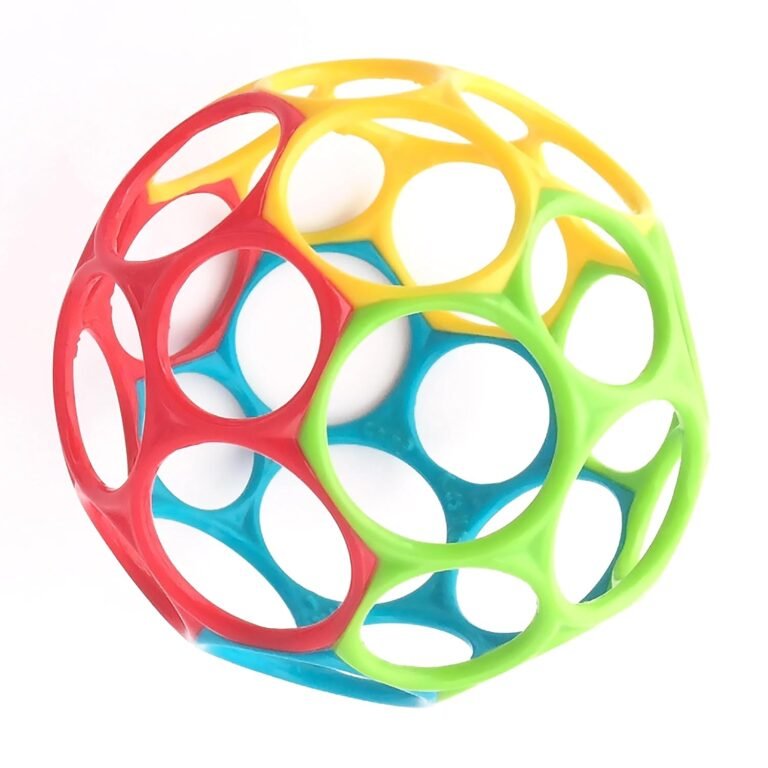
Rings, open-frame graspers, interlocking discs, soft balls, and lightweight rattles can all support this kind of exploration when the exact product is intended for the baby’s age.
Weight and shape matter. A beautifully made toy is not particularly useful if it is difficult for the baby to hold.
A toy that moves slightly away after being pushed can create a simple cause-and-effect sequence.
The baby touches or pushes the object, sees it move, and may reach toward it again. For babies beginning to pivot, scoot, roll, or crawl, that movement can make the environment more interesting without requiring an electronic response.
Bell cylinders, rolling balls, soft textured balls, and similar toys can work well when their movement is noticeable but not so fast that the object immediately disappears across the room.
Our Montessori ball toys guide covers rolling toys, ball trackers, and drop activities in more detail as those become appropriate.
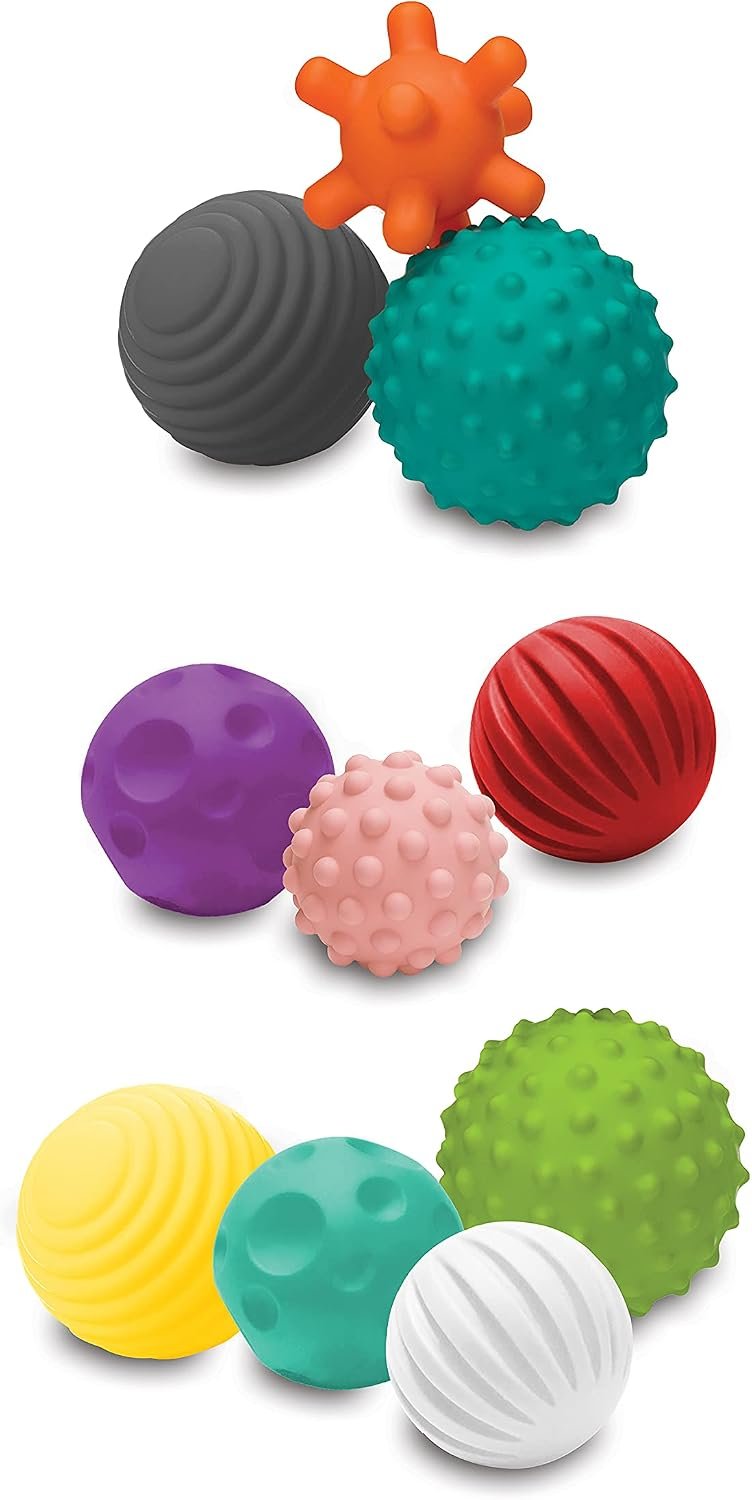
A sensory ball can combine several useful characteristics in one simple object.
The baby may grasp it, squeeze it, transfer it, roll it, mouth it where appropriate, or notice a difference in texture or weight compared with another ball.
That does not mean more textures automatically make the toy better. The surface should contribute something noticeable without making the object difficult to hold or clean.
For a six-month-old, diameter, firmness, grip, washability, and manufacturer guidance usually matter more than how many sensory claims appear in the product description.
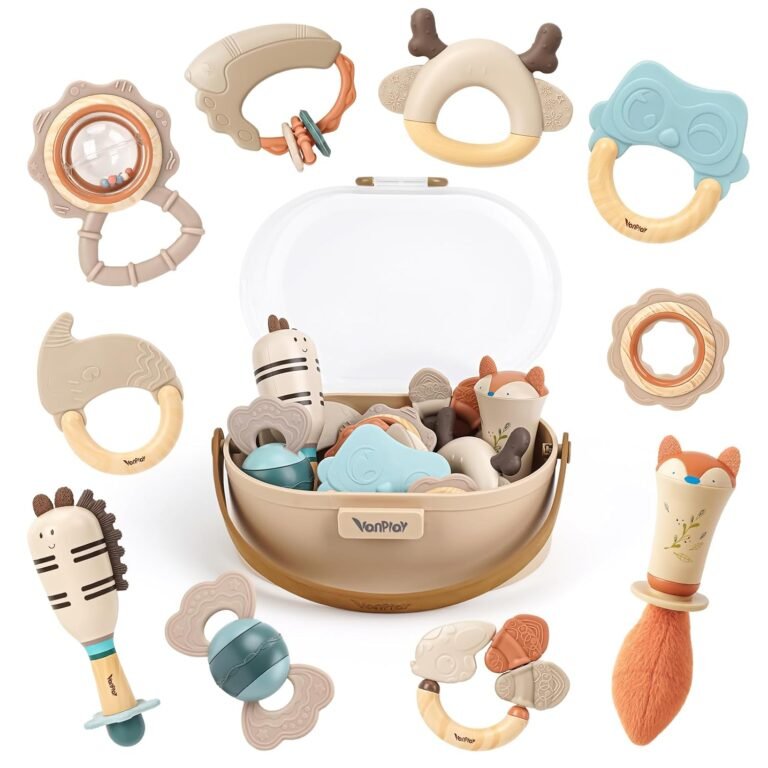
At six months, a rattle can become less about listening to a caregiver create sound and more about the baby producing the sound independently.
That makes the action especially clear: shake, hear, stop, repeat.
When comparing rattles, look at grip, weight, sound level, construction, whether internal components are securely enclosed, and how easily the toy can be cleaned.
A subtle bell or enclosed rattle can be just as interesting as a louder product. Volume should not be confused with usefulness.
A six-month-old does not need to build a perfect tower for stacking cups to be worthwhile.
At this stage, cups may be held, mouthed, banged together, turned over, placed inside one another with help, knocked down, or used as simple containers.
That gives the same set room to change as the baby’s hand control develops.
The best early sets are usually easy to grasp and do not overwhelm the baby with too many small components.
Nesting cups can also be practical because they store compactly and may continue to offer different activities later.
A simple basket containing a small number of suitable household objects can offer varied textures, weights, shapes, and materials without requiring a specialized electronic toy.
The value comes from exploration, not from having a large collection.
At six months, every object needs to be considered carefully because mouthing remains likely. Small parts, cords, breakable objects, sharp edges, detachable pieces, unsuitable coatings, and anything that could present a choking or strangulation risk should be excluded.
A commercial treasure basket should be assessed with the same care as a homemade one.
Teething products are common around six months, but a Montessori label does not change the basic buying criteria.
A teether should be intended for infant mouthing, easy enough to grasp, constructed appropriately for its purpose, and practical to clean according to the manufacturer’s instructions.
Material claims should also remain specific. Terms such as food-grade silicone, natural rubber, BPA-free, or non-toxic should only be repeated when they are supported for the exact product.
Appearance is not evidence.
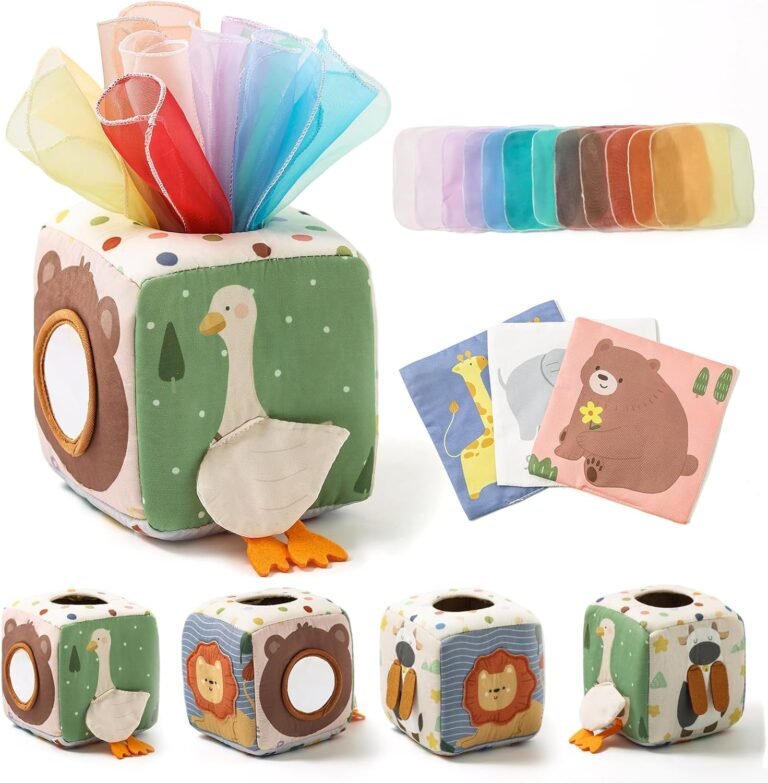
Soft books and early play books can add another type of interaction without requiring precise fitting or problem-solving.
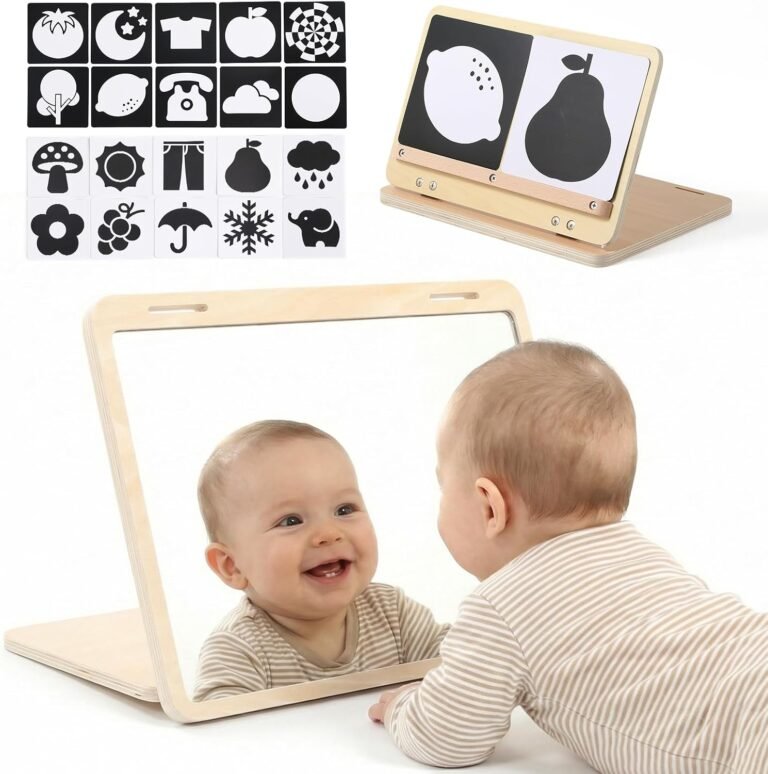
A six-month-old may grasp pages, turn or crumple soft sections, look at high-contrast images, touch different materials, or bring parts toward the mouth.
The practical differences are often in construction. Check whether attached elements are secure, whether the book is washable, and whether mirrors or textured components are designed for infant use.
For this age, a book can be useful even if the baby is not “reading” it in any conventional sense.
Mirrors are often introduced much earlier, but they can remain interesting as babies become more mobile.
At six months, a baby may approach a floor-level mirror differently than they did as a newborn. They may reach toward the reflection, shift position in front of it, or use it while sitting or moving on the floor.
A mirror intended for infant use should be securely positioned and appropriate for the setting. Ordinary household mirrors should not be assumed suitable simply because the activity itself is simple.
A major practical difference around six months is that toys may begin interacting with the baby’s increasing mobility.
A ball that once stayed beside the baby may now roll away and invite reaching. A low basket may become something to explore independently. A toy placed slightly to one side can become more interesting as the baby pivots or changes position.
This does not mean toys should be used to force movement or accelerate milestones.
It means the environment can make existing movement more purposeful by placing a small number of interesting objects within a realistic range.
Accessibility matters at this stage.
A useful activity can be difficult to explore if the object is consistently too far away. At the same time, surrounding the baby with a large number of toys can make it harder to see what they actually choose.
A few accessible objects can make observation easier for the parent and choice clearer for the baby.
This is also where a small toy rotation can be practical. A toy does not need to stay permanently available if the baby is no longer interested in it.
Product collections for babies sometimes include shape sorters, object permanence boxes, stacking towers, and other more structured toys under broad 6–12 month labels.
That does not mean every six-month-old needs them immediately.
At this stage, the more meaningful activity may still be holding the piece, banging it, transferring it, turning it over, or dropping it rather than intentionally placing it through a specific opening.
There is no advantage in buying ahead simply because the next activity appears more advanced.
Our Montessori toys for 6–12 month olds guide covers those increasingly deliberate activities across the second half of the first year.
At six months, mouthing should be expected with many handheld toys.
That makes size, detachable components, finishes, seams, adhesives, and cleaning instructions especially relevant.
Wooden toys are not automatically suitable for mouthing, and silicone products are not automatically safer simply because of the material category. The intended use and manufacturer information for the exact item matter.
Products also change over time. A toy that becomes cracked, damaged, swollen, loose, or otherwise deteriorated may need to be removed even if it was originally appropriate.
A toy that is handled and mouthed repeatedly will need regular maintenance.
Some silicone and plastic products can tolerate more thorough washing, while fabric, unfinished wood, painted wood, and mixed-material toys may need different care.
The manufacturer’s cleaning instructions should guide what you actually do.
Practical cleaning is worth considering before purchase. A toy that looks appealing but is unnecessarily difficult to maintain may not be the strongest choice for a baby who explores with their mouth.
For this page, we prioritize what the baby can actually do now.
We look at whether the activity involves grasping, transferring, shaking, rolling, reaching, mouthing, knocking over, exploring materials, or another action that makes sense around six months.
We then consider manufacturer age guidance, object size, weight, grip, detachable components, cleaning, materials, sound, storage, and how much adult setup is required.
We are also cautious about toys whose main value depends on an activity the baby is unlikely to use yet. A set may have excellent long-term potential, but that is different from being especially useful at six months.
Our Montessori toy review process explains how we evaluate products without presenting research-based observations as first-hand testing.
This page deliberately owns the exact six-month stage rather than trying to cover the entire first year.
For younger babies still focused more heavily on visual observation, early grasping, and first hand-to-hand play, use our Montessori toys for 0–6 month olds guide.
For babies moving beyond this transition into more deliberate releasing, retrieving, filling, emptying, simple fitting, and increased mobility, continue to Montessori toys for 6–12 month olds.
Our broader Montessori toys for babies guide brings the entire first year together when you need a wider overview.
Disclosure: The Little Montessori may earn a commission from qualifying purchases made through links on this page, at no additional cost to you.