


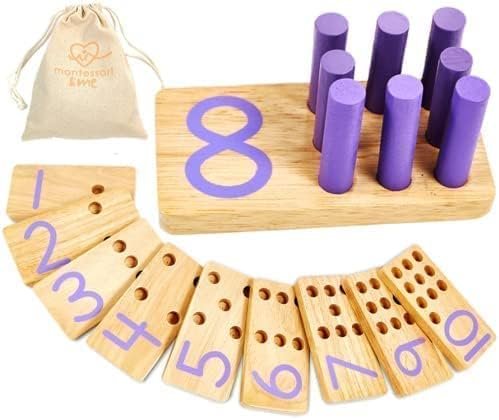

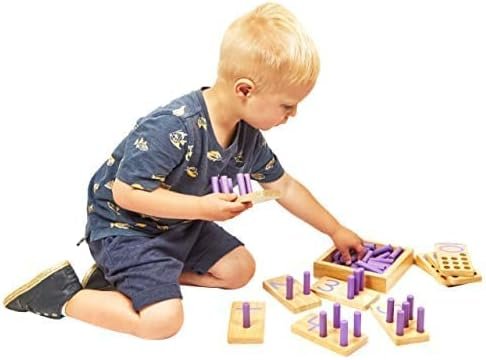

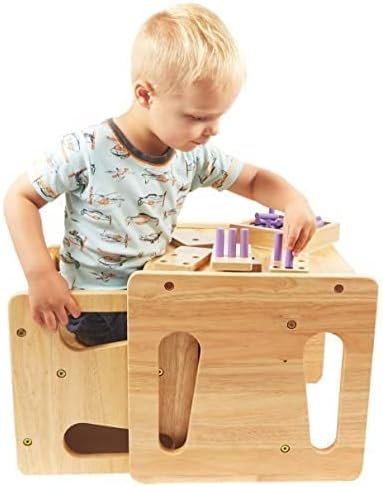

The Montessori & Me Counting Peg Board gives a 3-year-old a concrete way to connect written numerals with actual quantities. Rather than counting pictures on a page, the child places wooden pegs into numbered boards and can see how the amount changes as the numbers increase.
That makes the activity useful for early number recognition, one-to-one correspondence, sequencing, and counting while also requiring controlled hand placement.
Three-year-olds beginning to recognize numerals and connect spoken numbers with concrete quantities.
Disclosure: The Little Montessori may earn a commission from qualifying purchases made through links on this page, at no additional cost to you.
The core activity is simple: the child selects a numbered board and places the corresponding number of pegs into it.
That physical relationship matters because the numeral is not presented only as an abstract symbol. The child can handle the quantity, count each peg individually, and see that a larger number requires more objects.
Within our Montessori toys for 3-year-olds lineup, this gives early math its own clear role rather than treating counting as a secondary feature of another toy.
This set fills the early numeracy role in the 3-year-old recommendations.
The Oomloid animal set supports counting while primarily functioning as a sorting and tweezer-transfer activity. The Montessori & Me peg board puts number-to-quantity relationships at the center of the work.
That distinction matters. A child can practice recognizing the numeral, counting out the corresponding number of pegs, and checking the relationship visually and physically.
The design is closely aligned with Montessori-style concrete math work, though we would avoid implying that every branded commercial product marketed this way is a standard classroom material.
The activity contains numerous loose wooden pegs, so it requires more piece management than a fixed puzzle or single-board toy.
A newly 3-year-old may also be more interested in inserting and removing the pegs than in matching every board to the correct quantity. That does not make the activity unsuccessful; the mathematical relationship can become more meaningful through repeated use.
Adults should resist turning the set into constant testing. Demonstrating the activity and allowing the child to repeat it independently is generally more useful than repeatedly asking for correct answers.
A useful feature of the peg-board format is that it keeps early math concrete.
When a child counts five pegs into the board marked 5, each spoken number corresponds to one physical object. That one-to-one relationship is more foundational than expecting a 3-year-old to perform written arithmetic.
The boards can also be arranged in numerical order, allowing the child to notice how quantities grow as the sequence progresses.
As familiarity develops, the same pieces can support simple comparisons such as which quantity is larger or smaller.
The set is made primarily from wood and includes numbered boards with corresponding wooden counting pegs.
The manufacturer describes the material as hardwood with a smooth protective finish.
The complete set contains 67 pieces and is designed for hands-on counting, number recognition, sequencing, and fine-motor work.
No batteries or electronic components are required.
The manufacturer age guidance for this exact product is 36 months to 5 years.
That makes age 3 directly appropriate for the set rather than requiring us to reinterpret its intended use.
Because the activity includes numerous small wooden pegs, families should follow the manufacturer age guidance and keep the pieces away from younger children who may still mouth small objects.
The boards and pegs should also be inspected periodically for damage.
This set may suit a 3-year-old who has begun noticing written numbers, enjoys counting objects, or likes placing small pieces into defined positions.
It can also work well for children who benefit from seeing an abstract idea represented physically rather than through worksheets or screens.
The individual boards allow families to present only a few numbers at first instead of introducing the entire set at once.
Children who are not yet interested in numerals may engage more consistently with sorting, building, pretend play, or movement activities.
The numerous small pegs also make this less convenient for travel or casual floor play.
Families looking for a completely self-contained activity with no loose pieces may prefer a puzzle or fixed counting board.
Brand: Montessori & Me
Product: Counting Peg Board
ASIN: B0994X5329
Manufacturer Age Guidance: 3 to 5 years
Piece Count: 67
Primary Material: Wood
Primary Activities: Counting, number recognition, one-to-one correspondence, sequencing, fine-motor placement
Operation: Manual
Batteries: None
Assembly: None